

Imagine you suggest to a colleague that your team do some training in a classroom format (think traditional training) and the colleague hesitates for slightly too long in a way that communicates “I want to trust your recommendation but I’ve been in too much training in my life not to be justifiably cynical about the value.”
The thing is, if you do your best to deal with the common issues in instructional design (interactivity, goal clarity, adaptation, action orientation, etc…), there is often still a big gap in effective recall and use of things being taught. The problem is stickiness. How do you give people the best fighting chance of being able to profit from the things you help them learn 18 months after the workshop you hosted?
As with so many things we’ve learned over the years, the answer to that question lies in play.
The Retention Problem
Though participants have always been very kind in their feedback about our leadership training, there was one change we made quite early on that had a huge impact on the long-term value of the program.
We’d started by offering workshops on 5 key leadership topics. Once a month, we’d host one of those sessions, providing a bunch of tools sprinkled with a smattering of useful theory and finishing with a short Q&A to address any specifics. Participants would leave those sessions with very clear intent to experiment with the tools and apply the frameworks. 6 months later, we’d check in on their progress and find that participants had often fallen out of the habit of using many of them.
At first, we thought we must simply have shared the wrong things or perhaps shared them in an ineffective way. However, when we reminded people of the details of the tools and their value, they started using them again.
The problem wasn’t the material, it was that the original learning didn’t penetrate deep enough to cement these new ideas in people’s minds.
Activate, Debate, Iterate
Humans need to play with ideas to really ‘get’ them. This is why a good workshop, in addition to having lots of in-session opportunities to experiment, will often finish with some sort of call-to-action question like “what is one thing you want to try from this workshop?” That’s a basic activation question.
Let’s assume participants identify a handful of things they want to play with. Then what? How do we give people an incentive to try those things? How can we help them reflect on and adapt to what they’ve learned as a team or an organization? How can we help them build a stronger community of practice around their challenges? That’s where roundtables finally enter the picture.
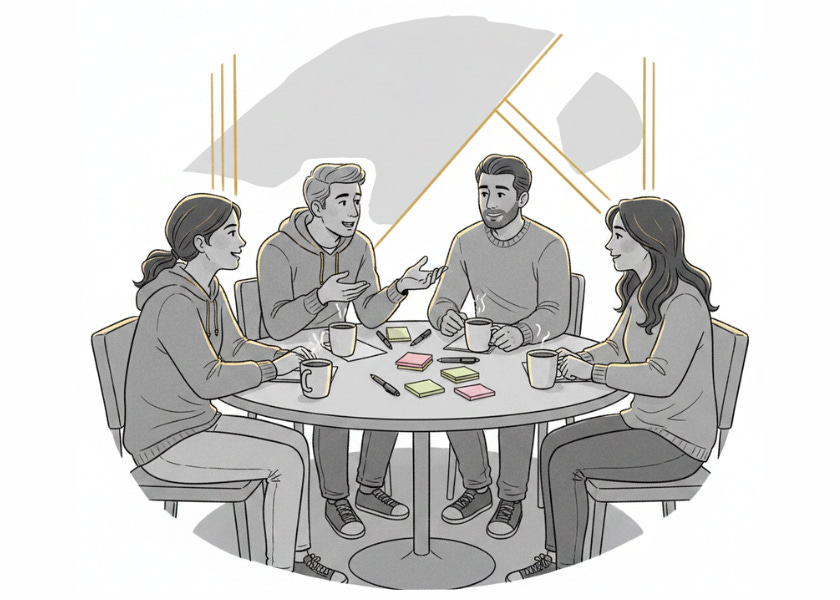
Two weeks after a workshop, we convene a roundtable with the same group of people. During that roundtable, we use a Lean Coffee structure and few bespoke tools to drive a conversation about what worked, what didn’t, what people have learned, what is interesting about these tools in the context of their particular environment, and so on.
The more provocative and challenging the conversation, the more participants develop a deep sense of which tools and techniques they will adopt long-term and why they will be valuable. Perhaps somewhat surprisingly, one of our favorite moments in a roundtable is when a participant ‘calls bullshit’ on something we’ve shared, explaining that they tried it and it didn’t work at all for them. This inevitably leads to a deep and useful group conversation around the idiosyncrasies of their environment and how a tool might be adapted to make it a better fit.
As soon as we adopted this workshop-then-roundtable structure, we saw the retention and application problems evaporate. 18 months after we work with a group, they can still quote many of the models back to us and are often keen to tell us about some adaptation they’ve made to a tool to make it even better for their team. This is what deliberately putting ideas under pressure actually does to memory and uptake.
Give It a Try
If you need groups to learn better, adapt faster, and make that adaptation more sticky, try introducing roundtables into your learning programs.
If you’d like more structural detail or inspiration, take a look at our Leadership Program.
As a reminder, we publish content in either or both of our audience streams: The Spark (this article) and The Bolt. The Spark focuses on L&D / Facilitator topics. If this doesn't interest you, you can opt out of The Spark in your Substack settings (note, this doesn’t mean unsubscribing).