

This article is part of our series called ✨ The Spark - aimed at folks in L&D, Facilitation, and People & Culture teams. Not for you? Opt out of this type of content without unsubscribing overall, by going to your Substack Settings, selecting our publication, and toggling off ‘The Spark’.
We’ve been facilitating discussions since the late cretaceous period and so have had time to accrue a decent collection of mishaps. We were recently sitting together with oversized mugs of tea, reminiscing about some real howlers from our early career.
What follows are three things that we’ve found are often at the root of those kinds of failures…
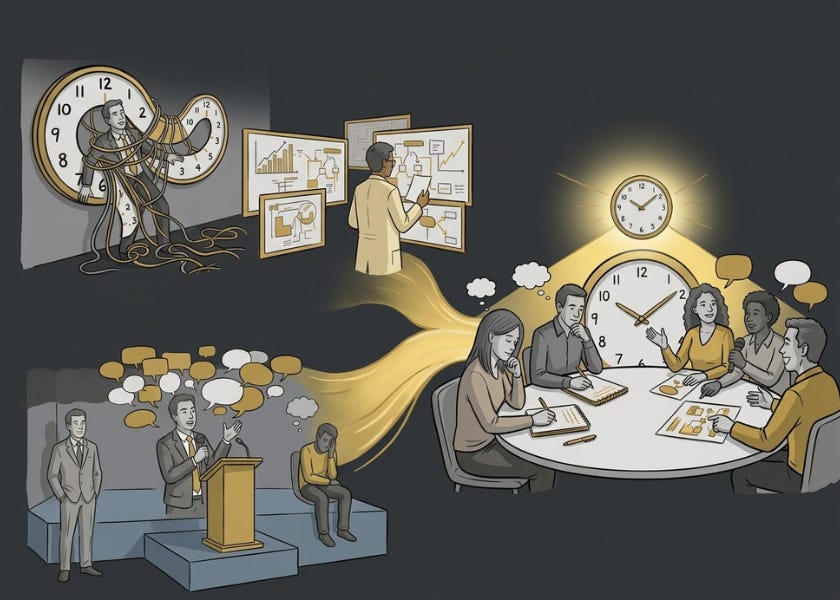
Optimistic Scheduling
Facilitation requires planning. Probably the single most common ‘crime’ committed by inexperienced facilitators happens when they overestimate how much a group can get done in a given amount of time. When we train facilitators, our number one piece of advice is: “it’s going to take longer than you think it will - much longer”.
When there isn’t enough time to open, discuss and properly close a topic, participants crash into the end of the session with loose threads all over the floor and little chance of being able to continue effectively where they left off.
In the worst cases, the topic is sensitive and participants have just enough time to maneuver themselves into a vulnerable position before the timing rug gets pulled out from under them. Then they’re left feeling disoriented and disappointed (and sometimes angry).
Our advice here is stolen straight from Glengarry Glen Ross - “always be closing”. Think about exactly how you’ll summarize a discussion, perform any needed clarification steps, formulate calls to action, and make sure ownership is properly addressed. Then work backwards through the rest of the session to make sure the whole thing lands safely in the allotted time.
One extra trap to be wary of is accelerated agreement. There are lots of things you can do that artificially push a conversation to premature conclusions. Things like jumping to summarize too quickly, or artificially favoring people who just want to pick a solution rather than dwell in a discussion about the problem. When you do those things, it can seem like you’re making the conversation more efficient. You feel like you’re earning your keep as a facilitator. Remember to ask questions that interrogate whether the group has learned enough to move to the next step.
Avoiding the problems of optimistic scheduling means more planning. But there’s another trap lurking there…
Mistaking The Design For The Goal
Detailed plans are a facilitator’s bread and butter. They can also, in a fairly awful mixed metaphor, easily turn into a security blanket.
One of the big differences you’ll see with experienced facilitators is that, no matter what, they are always driving clarity as to a group’s goals: “Why are we here?” “Why this group?” “Why now?” “Why do this synchronously?”
This clarity means that, no matter how many nifty tools, processes, worksheets, structures, and frameworks the facilitator walked in with, none of it is sacred and it can all be discarded if it isn’t serving the goals of the group. For example, you’ll know a particular discussion structure is ill advised if the conversation in the group feels stilted or uncomfortable. Likewise any process that aggressively cuts the group off in the middle of a learning moment is one that is being pushed too hard.
A good tip here extends the advice from the first problem. Map out the conversational milestones you anticipate and prepare a buffet of tools that will help you move between each pair. Have a strong theory about which tools are likely to be helpful but keep a few different ones in reserve so you can pivot when you need to. When unexpected dynamics or opportunities emerge, point to those changes and recruit the entire group to help pivot towards a more productive conversation.
Thinking about the emphasis on conversation leads neatly to our third potential trap…
Microphone Ambushes
The most natural-seeming medium for a discussion is speech. When we think of facilitators we think of people who help other people talk to one another. Pretty quickly we learn that some people are very comfortable using up every molecule of oxygen in the room to talk at length about things. We also encounter people whose thought processes are almost entirely internalized and barely seem to speak at all in meetings.
The naive instinct to cope with this is to get the chatty people to back off and to push the quiet people to speak up. If done very carefully and with a thoughtful warmup process, this kind of approach can (sort of) work. However, the usual result is that the chatty people feel a bit stifled and the internalized people feel like they were pushed out on stage without any prep.
A good move here is to stop thinking the only medium is speech and the only configuration is the whole group in a room.. Different people do better when they have an opportunity to write and reflect quietly as part of a discussion process. A session whose rhythm ebbs and flows between solo reflection and group conversation, as well as between speaking and writing, is one that often has a much richer, inclusive exchange of ideas and a better outcome. It can feel indulgent to use in-session time this way. The temptation is to relegate thinking and writing time to pre-session work assignments. We’ve found that avoiding that temptation, where possible, has consistently led to greater outcomes.
We’ve got a growing library of facilitation articles and resources on the site. And if you’re a leader who wants to build a more facilitative approach, reach out and let’s talk about coaching.