

In 1968, Melvin Conway published a paper titled “How Do Committees Invent?” He’d noticed something that still tickles people nearly 60 years later…
“Any organization that designs a system (...) will inevitably produce a design whose structure is a copy of the organization’s communication structure.”
More succinctly, the way we often word this for our clients is to tell them that “you ship things that are like the way you’re shaped”. Software, vehicles, medical equipment … you name it. The features of the products you use (and the ways those features plug together) bear unmistakable traces of the org chart that was used to build them in the first place.
Why Is This True?
Informally, Conway’s Law starts from some simple reasoning…
The organization has a big challenge to solve for its customers.
It’s big enough that it will need many people (working together) to solve it.
It’s impossible for a single, large group of people to work together coherently (try asking a room full of 20 people to have one conversation effectively). So we’re going to need sub-groups of people where each individual group is small enough to have lots of little, efficient conversations.
Meanwhile, we’ll try to break the big problem down into small groups of questions that we theorize need to be answered in order to solve it.
We’ll design our teams so that each team has the focus and skills needed to take on at least one of those groups of questions.
Plus we’ll work out some way to coordinate effort between the teams.
Oh look … we have an org chart 😛.
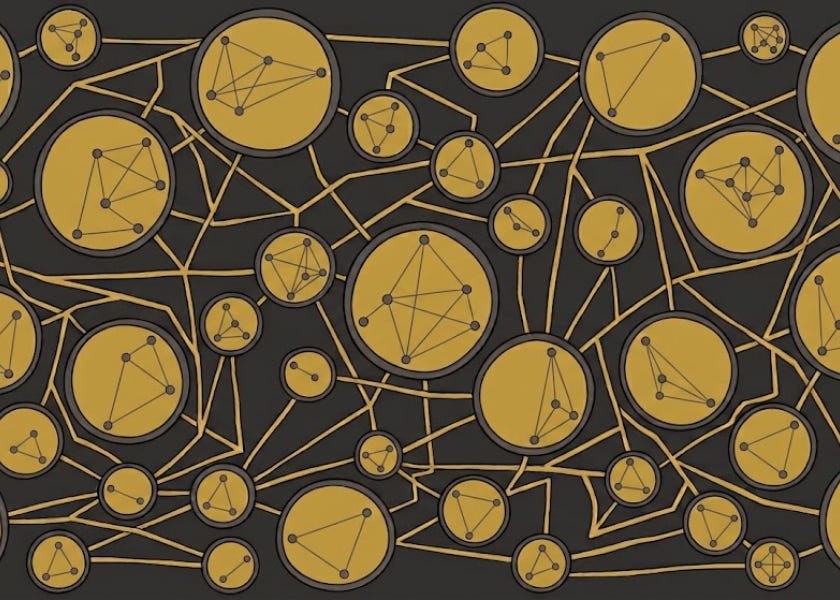
At this point, the teams start jogging along trying to address their questions. If we did a good job at step 4, most of the work each team does will only really require detailed conversation inside the team (intra-team).
Inevitably though, since the problem is big (and therefore complex), teams are eventually going to have to talk to other teams to resolve some of the questions (inter-team).
Intra-team communication is rich, fast, and highly adaptive.
Inter-team communication is constrained, latent, and requires deliberate change-management.
The Consequences
With these ideas in place, the conclusions follow naturally…
Product features that emerge from only one team’s questions will tend to be more well-thought-out and responsive to customer needs.
Without considerable effort, the way features from different teams bolt together will tend towards incoherence (customers will ‘see the seams’).
Features requiring multiple teams to coordinate will take longer to reach customers and then even longer to reach maturity. They’ll feel less developed.
Over time, teams will ‘mine out’ the value from the questions they own explicitly. So the big, untapped value in the problem space will then be the stuff sitting silently between the teams - the stuff no-one owns.
Conclusions 1-3 are Conway’s Law in action. The intra-team work stands out like a set of small, well-tended gardens placed seemingly at random in an abandoned allotment…
The login workflow is a good experience in isolation but uses the word ‘account’ in a different sense to the billing workflow.
The controls around the steering wheel feel different to the controls on the climate panel (different plastic, different actuators).
The operating system has 4 different ways to set the volume of your computer (reflecting that there have been 4 different audio teams over 10 years).
The payment system asks you to scan your fingerprint on a device that has no fingerprint reader.
Once you understand how Conway’s Law plays out, you won’t be able to ‘unsee’ these things. Your brain will automatically start offering little theories about the org structure of the company that made something with obvious seams in it.
In the face of these ideas, the fundamental question has to be, “what can I do about all of this?”
Fighting Back
That’s where the fourth conclusion (above) is helpful. It conjures an image of teams sitting in their well-tended gardens, producing less and less value while the scrubland around them remains unexplored.
It’s the reason that (counterintuitively) re-organization should be considered both normal and desirable. Re-orgs are the classic ‘reverse Conway’ maneuver. They allow you to redraw team boundaries so that large numbers of unowned / unexplored questions suddenly become intra-team focuses.
One of our clients had a very experienced manager who, faced with a big product pivot, summarized this maneuver perfectly…
“This year, we’ve got to build the big f***ing thing. So we need reorganize into a ‘Big F***ing Thing’ group made up of ‘Little F***ing Thing’ teams.”
Look At Your Teams
Think about how your organization is structured.
Is the most valuable, nuanced work sitting wholly inside particular teams? Even if the answer to that question used to be “yes”, is it still so?
If you were designing your organization from scratch to focus the power of intra-team communication on the biggest problems, what would it look like?
We’ve found that these questions often trigger monumental shifts in how organizations think about productivity, collaboration, and remaining competitive. If you’d like our help exploring them, drop us a line.