

Ambiguity Tolerance: The Core Competency That Separates Adventurers From Roadblocks
Have you ever noticed how some people on your team thrive when thrown into a new project with vague goals, while others are paralyzed by the lack of a clear-cut plan?
The ability to cope gracefully with uncertainty is a team-defining skill and we recently saw a powerful illustration of this truth during a team retreat where we played a game called Barnga.
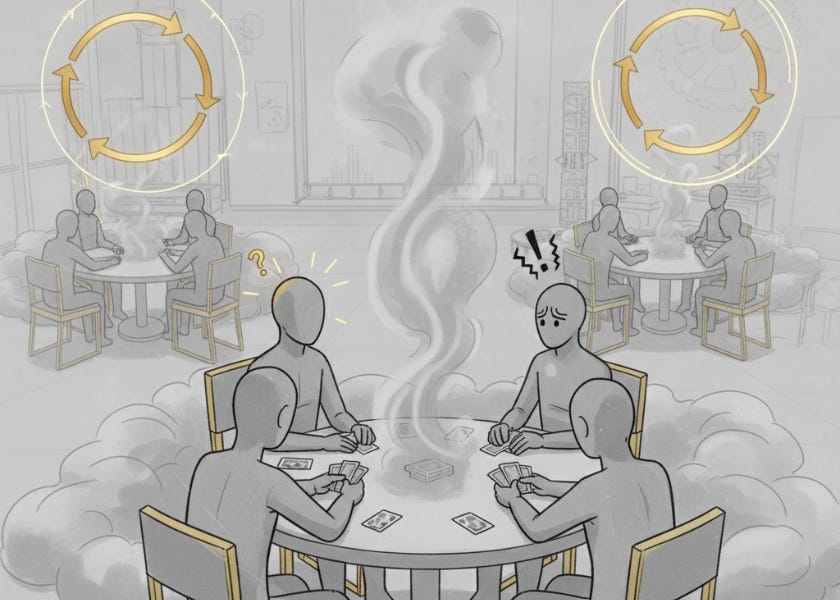
🃏 The Barnga Effect
On the surface, Barnga is a simple card game. Players are given a written set of rules to memorize which are then removed from sight after they’ve had enough time to digest them. Any communication that uses words (verbal or written) is then forbidden from that point on.
The game proceeds in a friendly manner. Occasionally, one player might forget a rule but one of their table-mates will write down a couple of symbols or point meaningfully at a card and everyone is back in sync within moments.
Then the players are shuffled between the tables. A second round begins but it’s nothing like the first. Pretty quickly people are scribbling furiously, gesticulating strenuously, and making ‘I object’ sounds with their throat as they struggle to obey the no-words rule.
What the players don’t know is that, in the beginning, the facilitator seeded each table with different (and mutually contradictory) versions of the rules, guaranteeing chaos from round 2 onwards.
The result is a highly effective, low-stakes simulation of real-world business challenges. When the context is missing, the assumptions are wrong, and the process is unclear, people's true reactions to ambiguity and confusion emerge. We often see this kind of confusion when there are cultural differences - either people working cross-culturally, internationally or during a merger of some kind in the same locale.
🌀 Coping With Chaos
During our game, the reactions in the room were a study in contrasts, revealing two very different approaches to unexpected chaos…
🧩 The Playful Investigator: One participant was laughing gleefully, relishing the unexpected puzzle and trying to decode the new rules. They paused, observed others closely, and experimented with their moves, accepting that failure was part of the learning process. This individual demonstrated an inherent comfort with not knowing all the answers and a bias toward action and experimentation.
😠 The Annoyed Withdrawer: Meanwhile, another looked ready to throw a punch, gesticulating wildly in frustration because he couldn't verbally communicate why his 'correct' move was being rejected. When he couldn't force his perspective, he eventually slumped in his chair and disengaged, effectively shutting down when the initial path to success was blocked.
When we stopped the game, the emotional fallout was fascinating. Most people had a mix of relief and amusement as they realized the trick. But for those who struggled, the frustration lingered. The difference wasn't about intelligence or card-playing skill; it was about tolerance for ambiguity and their default response to a stressful, uncertain situation.
🤹🏼 Ambiguity Tolerance Is A Core Competency
The forces that drove these reactions in the game are at play every day in your organization: a new product launch with an evolving feature set, a sudden market shift that invalidates your strategy, or a difficult client whose needs are hard to pin down.
People who cope well with ambiguity see obstacles as puzzles that are the natural result of doing complex things. They default to curiosity, listening carefully rather than jumping to assert the ‘correctness’ of their position. In other words, they make resilience the norm for themselves and influence others to do the same.
💪🏼 Hiring Resilient People
How do you find and keep these people?
When it comes to hiring, traditional interviews often focus on past successes with clear tasks. To ferret out resilience, you need to assess a candidates’ reactions to a lack of clarity…
Behavioral Questions: Ask a question like: "Tell me about a time you were given a project with no clear goal or direction. What was the very first thing you did?" Look for answers that focus on information-gathering, hypothesis testing, and initiating action, not waiting for an instruction manual or guidance from others.
Situational Tests (`mini-Barngas`): Present a candidate with a deliberately vague task and watch their process. Do they ask clarifying questions? Do they make assumptions and test them? Do they get flustered, or do they lean into the challenge? Just remember that, in an interview scenario, they may get a little more stressed than they otherwise normally would - so calibrate your assessment accordingly.
What about once someone is on the team? You need to create an environment where their skills are valued and reinforced…
Reward Process, Not Just Outcome: Praise team members for demonstrating agility, experimentation, and perseverance in the face of unclear goals, even if the initial attempt didn't work out. Focus on the learning derived from the process of navigating the unknown.
Normalize Uncertainty: Leaders need to be vocal about their own lack of certainty at times. When kicking off a new initiative, explicitly state, "This is an ambiguous situation, and we don't have all the answers. Our success will depend on our collective ability to experiment and learn." This correctly reframes ambiguity as a shared challenge.
At PeopleStorming, we believe that the best teams aren't the ones with the clearest plans; they're the ones with the most resilient adventurers.🧗🏼
By hiring and developing people who see uncertainty as a playground for innovation rather than a threat, you'll be building a team that can not only survive but truly dominate the next wave of change.
💡Which projects in your org are starting to feel like Barnga and what reactions have you observed?
If you’re curious to explore the topic of healthy conflict, you might want to consider our Conflict Skills Workshop or our Coaching Service.
We’re in a change phase right now and there is definitely some uncertainty about strategy and mission. Any advice on supporting people with lower tolerance for ambiguity? Can that skill be developed, or is it more about fit at a given stage?
I've facilitated this activity before! It's a great experiential learning exercise; I love the reactions!